
Start Your Career in Healthcare Management After 12th in Science Stream (PCB) with DMLT Course

Updated Post: 01 Jul 2026
Share Post:



Overview
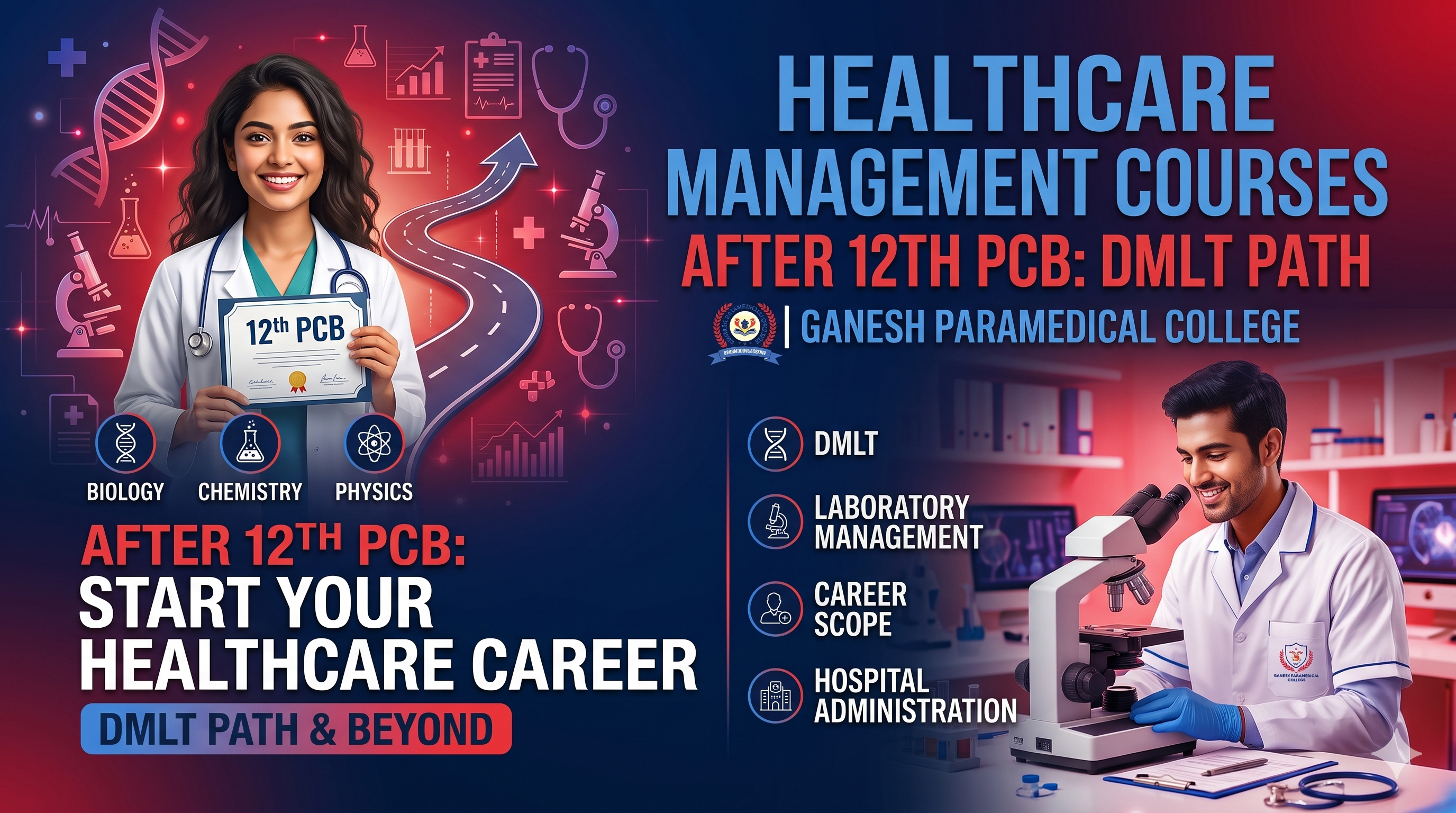
If you have completed Class 12th in the Science stream with PCB and are searching for a practical, job-focused course, you may be exploring Healthcare Management Courses after 12th PCB along with strong paramedical options. One of the smartest starting points is the Diploma in Medical Laboratory Technology (DMLT course). It helps students enter the healthcare industry quickly, build real hospital exposure, and later move towards administrative and healthcare management roles.
This guide explains the DMLT course, eligibility, admission process, subjects, skills, career scope, salary, and how students can grow from lab-based roles into healthcare operations and management. It also highlights how Ganesh Paramedical College supports students with career-oriented training and guidance.
What is the DMLT Course?
The DMLT course (Diploma in Medical Laboratory Technology) is a paramedical diploma designed to train students in medical diagnostic procedures. Students learn how laboratory tests are performed on blood, urine, and other samples to help doctors identify diseases and plan treatment. Since accurate diagnosis is the backbone of healthcare, DMLT professionals are valued across hospitals, diagnostic centres, and laboratories.
This course is designed to provide students with practical skills along with essential theory. It also builds a strong foundation for students who want to pursue higher studies or move into medical management and healthcare operations over time.
Course Highlights: DMLT After 12th PCB
Particular Details Course Name Diploma in Medical Laboratory Technology (DMLT) Course Level Diploma (Paramedical) Duration Usually 2 years (may vary by institution) Eligibility 10+2 (PCB preferred); minimum marks may apply Admission Process Merit-based or institute-level process (varies) Average Fees Approx. ₹30,000–₹1,50,000 per year (varies by college and facilities) Average Starting Salary Approx. ₹2.0–₹4.0 LPA (role, location, and employer dependent) Top Recruiters Hospitals, diagnostic chains, NABL labs, public health programmes, NGOs Job Roles Lab Technician, Phlebotomist, Lab Assistant, Quality Assistant, Lab Coordinator
Why DMLT is a Strong Choice for Career Options After 12th PCB
Many students believe that a PCB background only leads to MBBS or nursing. In reality, there are multiple career options after 12th pcb that offer stability, respect, and growth. DMLT is popular because it provides faster entry into the healthcare industry with real clinical exposure.
- Quick employability: Students can start working sooner compared to long medical degrees.
- High demand: Labs are essential for diagnosis, screening, and monitoring treatment.
- Career growth: With experience and upskilling, students can move into lab supervision, quality roles, and healthcare operations.
Types of Work Areas Covered in DMLT
During the programme, students learn and practice across major laboratory sections. This helps them understand how different departments function, which is also useful for those aiming for healthcare management roles later.
- Pathology: Study of disease through tissue and sample analysis.
- Microbiology: Testing related to bacteria, viruses, and infections.
- Biochemistry: Tests related to sugar, liver function, kidney function, cholesterol, and more.
- Hematology: Blood tests such as CBC, blood grouping, and clotting studies.
- Immunology/Serology: Antigen-antibody based tests used for many infections and conditions.
Eligibility Criteria (Simple and Student-Friendly)
Eligibility can differ slightly by state and institute, but the basic requirements are usually similar.
- Passed 10+2 (Class 12th) from a recognized board
- Science background preferred (PCB is ideal)
- Minimum aggregate marks as per institute rules (often 45%–50%)
Requirement Typical Criteria Education Class 12th (10+2) Stream Science (PCB preferred) Minimum Marks As per institute norms (often 45%–50%)
Admission Process (Step-by-Step)
The admission process for DMLT is generally simple and student-friendly. At Ganesh Paramedical College, students also receive guidance so they can complete admission smoothly.
- Enquiry and counselling: Talk to the admission team to understand eligibility, fees, and course outcomes.
- Application form: Fill out the form online/offline as available.
- Document verification: Submit Class 10th/12th marksheets, ID proof, photos, and other required documents.
- Merit/seat confirmation: Seats are typically allotted based on eligibility and availability.
- Fee submission: Pay the admission fee to confirm your seat.
- Course orientation: Students receive academic schedules and training details.
Subjects and Syllabus Covered in DMLT
The programme provides comprehensive knowledge of laboratory science and diagnostic procedures. Subjects can vary, but this is a common structure.
Year 1 (Core Foundations)
Category Subjects/Areas Basics Human Anatomy & Physiology (basic), Medical Terminology, Basic Pathology Lab Fundamentals Laboratory Instruments, Safety & Hygiene, Sample Collection and Handling Core Lab Hematology basics, Clinical Biochemistry basics, Microbiology introduction
Year 2 (Advanced Learning + Practical Focus)
Category Subjects/Areas Core Lab Advanced Hematology, Clinical Pathology, Clinical Biochemistry, Microbiology techniques Quality & Systems Quality control basics, Documentation, Introduction to lab workflow and reporting Training Internship/Clinical training (as per institute/affiliations)
Practical Training and Internship Exposure
Practical exposure is one of the biggest strengths of a DMLT course. Students learn how real labs function, how samples are processed, and how reports are prepared. This clinical training builds confidence and improves employability. It also supports students who plan to move into healthcare operations later, because they understand workflow, timelines, quality checks, and patient handling basics.
Skills Required to Succeed in the Healthcare Industry
Along with technical learning, students develop job-ready skills that help in laboratories and management-oriented roles.
- Attention to detail: Accurate reporting depends on careful work.
- Basic computer skills: Many labs use digital reporting systems (LIMS).
- Communication: Coordinating with doctors, patients, and lab teams.
- Time management: Handling multiple samples efficiently.
- Teamwork and discipline: Healthcare settings require responsible behaviour.
Career Opportunities After DMLT (Jobs + Growth)
After completing the DMLT course, students can work in diagnostic laboratories, hospitals, blood banks, and public health programmes. With experience and upskilling, students can also move into supervisory roles and support functions linked to medical management.
Common Job Roles
- Medical Laboratory Technician
- Lab Assistant / Lab Attendant
- Phlebotomist (sample collection professional)
- Quality Control Assistant (lab quality checks and documentation)
- Laboratory Coordinator / Front Desk Lab Executive (workflow coordination)
- Lab Supervisor (with experience)
How DMLT Can Lead to Healthcare Management
If your goal is healthcare management, DMLT can be a strong foundation because it teaches you how one of the most important hospital units operates. After 1–3 years of experience, students can consider short-term management courses in hospital administration, healthcare operations, quality, or medical records. This combination often supports career growth into lab administration, operations coordination, and departmental supervision.
Top Recruiters for DMLT Professionals in India
DMLT graduates can find opportunities across the public and private healthcare industry.
- Multi-specialty hospitals and nursing homes
- Diagnostic centres and pathology labs
- Blood banks
- Government hospitals and public health programmes
- Research centres and healthcare NGOs
Examples of popular recruiters: Apollo Hospitals, Fortis Healthcare, Max Healthcare, Manipal Hospitals, Dr. Lal PathLabs, SRL Diagnostics, Metropolis Healthcare, Thyrocare (roles depend on vacancies and location).
Salary After Completing DMLT Course
Salary depends on city, employer type, skills, and experience. Here is a practical estimate for students planning their career.
Job Role Typical Salary Range (India) Lab Technician (Entry Level) ₹15,000–₹28,000 per month Phlebotomist ₹14,000–₹25,000 per month Quality Assistant / Documentation ₹18,000–₹35,000 per month Lab Supervisor (Experience Based) ₹25,000–₹50,000+ per month Lab/Operations Coordinator (Upskilled) ₹25,000–₹55,000+ per month
Future Scope: Higher Studies and Career Growth
The healthcare industry offers long-term growth. After DMLT, students can upskill and expand their career options based on interest.
- BMLT/B.Sc. MLT: For deeper knowledge and better career progression in labs.
- Hospital Administration / Healthcare Management: Short-term or diploma-level options can support administrative growth.
- Quality and Accreditation Learning: Understanding lab quality systems can help students move into supervisory roles.
- Specialized skill training: Advanced lab techniques, reporting systems, and patient handling.
Benefits of Pursuing DMLT After 12th PCB
- Career-oriented course: Designed to build job-ready practical skills.
- Strong healthcare demand: Diagnostic services are growing across India.
- Multiple career pathways: Jobs, higher studies, and management growth options.
- Meaningful work: Supports patient care through accurate testing and reporting.
- Stable and rewarding healthcare career: Good long-term scope with experience.
Why Choose Ganesh Paramedical College?
Choosing the right institute is important because it affects your learning quality and confidence. Ganesh Paramedical College focuses on student-centric, career-focused education.
- Experienced faculty: Students learn from trained professionals who explain concepts in a simple way.
- Industry-oriented curriculum: The programme provides strong theoretical knowledge along with practical learning.
- Practical exposure: Students learn diagnostic procedures with a focus on real-world skills.
- Student support: Guidance for admissions, learning, and career planning.
- Career-focused approach: Encourages students to explore growth options in laboratories and healthcare management.
If you want to build a stable career in the healthcare industry after 12th PCB, Ganesh Paramedical College can be a supportive place to begin your journey.
Frequently Asked Questions
Q1. Which is the best option: DMLT or direct healthcare management courses after 12th pcb?
If you want a practical entry into healthcare, DMLT is a strong starting point because it offers hands-on clinical training and faster employability. Many students later add healthcare management qualifications to move into administrative roles. This path helps you understand real hospital workflows before managing them.
Q2. What is the duration of the DMLT course?
The DMLT course is usually 2 years in many institutes. Some colleges may offer different structures depending on their academic system and training model. It is best to confirm the exact duration with the college at the time of admission.
Q3. What are the career options after 12th pcb if I do not want MBBS?
Students can explore several career options after 12th pcb such as DMLT, radiology/imaging, physiotherapy-related pathways, operation theatre technology, and other allied health programmes. These courses help students enter the healthcare industry and build stable careers with good future growth scope.
Q4. Can DMLT students work in hospitals and diagnostic centres?
Yes. DMLT graduates can work in hospitals, diagnostic laboratories, pathology labs, and blood banks. The course equips students with practical skills in sample handling, testing methods, and reporting support, which are essential in modern healthcare settings.
Q5. How can DMLT help in medical management and healthcare management?
DMLT gives you a strong understanding of diagnostic workflows, quality checks, and lab coordination. With experience and additional management courses, students can move towards roles like lab supervisor, quality documentation executive, or operations coordinator. This combination supports long-term growth in medical management.
Q6. Why should I consider Ganesh Paramedical College for DMLT?
Ganesh Paramedical College focuses on career-oriented training with student support. The programme provides comprehensive knowledge along with practical exposure to diagnostic procedures. Students also receive guidance for skill development and career planning, which helps them build confidence for jobs and further studies.
Conclusion
If you are looking for practical and career-focused healthcare management courses after 12th pcb, starting with the DMLT course can be a smart decision. It opens doors to various career opportunities in hospitals, diagnostic centres, laboratories, and healthcare institutions. With growing demand for skilled healthcare professionals, this course can support a rewarding and stable healthcare career, and it can also create a strong pathway towards healthcare operations and medical management roles. For student-centric training and guidance, Ganesh Paramedical College can help you take a confident first step.