Syllabus for Paramedical Courses

Updated Post: 05 Feb 2026
Share Post:



Syllabus for Paramedical Courses
Overview
Paramedical courses are in high demand due to limited skilled professionals in healthcare
industry and growth of healthcare industry. These courses are skilled based and students
are trained practically to know the basic laboratory procedures and protocols of the tests.
There are various types of paramedical courses and each having different syllabus as the
course opted. Paramedical courses include radiology, pathology, microbiology, medical
laboratory etc. Syllabus for each course is designed in such a way to train students and get
them skilled in the particular domain of healthcare.
What Student need to study in paramedical courses?
The syllabus depends on the course type student has opted for and there are different
types of courses and the syllabus depends on that. But some basic features of syllabus
include medical science subjects, clinical subject and practical training related to the
course.
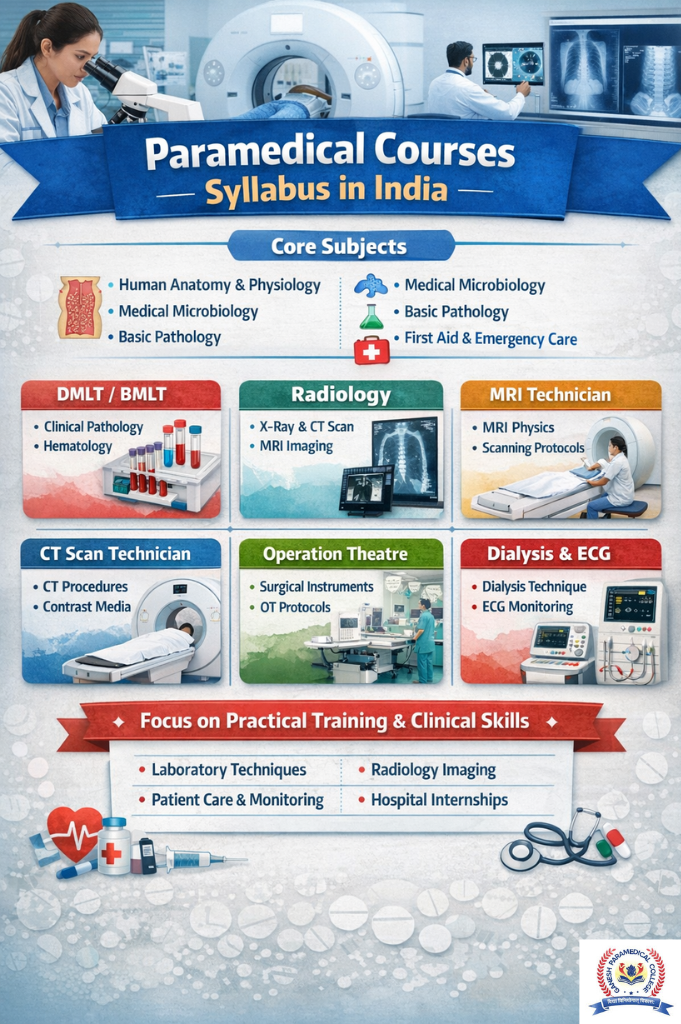
Common subjects include:
Human Anatomy and Physiology
Basic Pathology
Basic Microbiology
Biochemistry (Basics)
Pharmacology (Introduction)
First Aid and Emergency Care
Medical Ethics and Professional Conduct
Hospital Procedures and Patient Care
Communication Skills
What are the different types of courses and their syllabus?
1. DMLT / BMLT Syllabus (Medical Laboratory Technology)
Main syllabus topics:
Clinical Pathology
Hematology
Biochemistry
Microbiology
Immunology and Serology
Histopathology and Cytology
Blood Bank and Transfusion Science
Laboratory Instruments and Quality Control
Practical training includes:
Blood and urine analysis
Culture and sensitivity testing
Staining techniques
Microscopy
2. Radiology / Medical Imaging Syllabus
Main syllabus topics:
X-ray Technology and Positioning
Special X-rays and Contrast Studies
CT Scan Technology (Basics)
MRI Technology (Basics)
Ultrasound and Color Doppler (Basics)
Radiation Physics
Practical training includes:
Patient positioning
Image quality control
Exposure settings
3. MRI Technician Course Syllabus
Main syllabus topics:
MRI Physics and Principles
MRI Safety and Patient Screening
Cross-sectional Anatomy
MRI Sequences and Protocols
Contrast MRI Studies
Brain, Spine, Joint and Abdomen MRI protocols
Emergency management in MRI room
Image processing and reporting support
Practical training includes:
MRI machine operation
Patient handling and positioning
Coil selection and protocol setup
4. CT Scan Technician Course Syllabus
Main syllabus topics:
CT scan principles and working
Radiation dose management
Contrast media and safety
CT anatomy and cross-section
Trauma CT protocols
CT brain, chest, abdomen and spine imaging
5. Operation Theatre Technician (OTT) Syllabus
Main syllabus topics:
OT setup and surgical instruments
Sterilization and disinfection
Anesthesia equipment basics
OT safety protocols
Infection control in OT
Biomedical waste management
Practical training includes:
OT assisting
Instrument handling
Sterile procedures
6. Dialysis Technician Syllabus
Main syllabus topics:
Kidney anatomy with physiology
Dialysis machine operation
Hemodialysis procedure
Dialyzer and tubing setup
Water treatment system basics
Patient monitoring and vitals
Infection prevention and safety
Dialysis complications and handling
7. ECG Technician Syllabus
Main syllabus topics:
Basics of heart anatomy and function
ECG machine handling
Lead placement and patient positioning
ECG recording and basic interpretation
Stress test basics (in some courses)
Patient communication and safety
What is the course structure of paramedical courses having?
| S. No. | Component | What it Includes |
| 1 | Theory | Concepts, anatomy, procedures, protocols |
| 2 | Practical | Lab work, equipment handling, clinical skills |
| 3 | Internship | Hospital/diagnostic center training |
| 4 | Viva/Exams | Written + practical exams |
Practical training is the most important part because paramedical careers are skill-based.
What are the Benefits of Learning the Paramedical Syllabus?
There are various benefits of learning paramedical syllabus and these include:
Major benefits:
Clear understanding of course content
Better preparation for exams and practical
Helps choose the right specialization
Builds confidence for hospital training
Improves job readiness
Frequently Asked Questions (FAQ’s)
1) Are paramedical courses tough?
They have science subjects, which may be tough for some students.
2) Is paramedical syllabus lengthy?
Syllabus is designed as per courses and depends which course you are opting for.
3) Do I need to internship during the paramedical course?
Yes, internship is needed for the course completion.