
Paramedical College Programmes & bright Career Scope

Updated Post: 22 Feb 2026
Share Post:



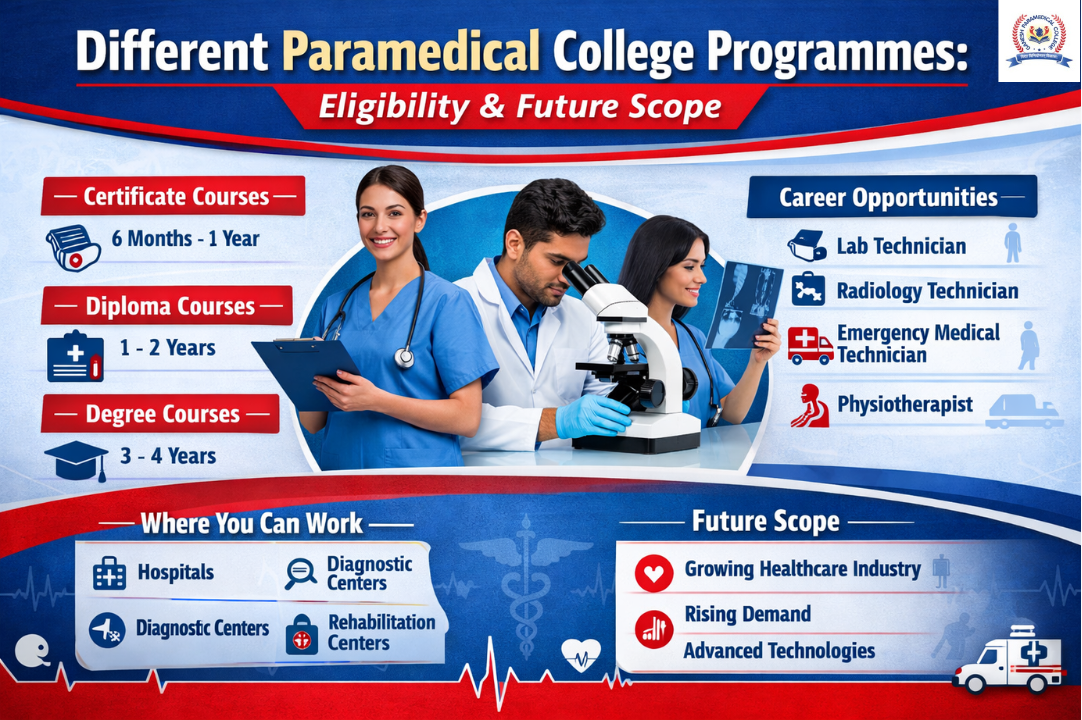
Different Paramedical College Programmes: Eligibility and Future Scope
Overview
Paramedical college programmes play a vital role in maintaining the healthcare and provides great job opportunities for the skilled professionals in healthcare industry. Paramedical college programmes are designed in such a way that skilled professionals for healthcare can be ready. There are various types of courses in the paramedical colleges and these include both diploma and degree course. There are different types of scope and eligibility for each course depends on the student taking the course.
What are Paramedical College Programmes?
Paramedical college programmes are both diploma and degree course designed to created skilled professionals for the healthcare industry. There are various focuses of these programmes and these include:
- Diagnostic services
- Therapeutic services
- Emergency and trauma care
- Rehabilitation support
- Laboratory technology
- Imaging technology
What are the Different Types of Paramedical College Programmes?
1. Certificate Courses (6 months to 1 year)
These are short-term programmes designed for quick job entry.
Popular certificate courses include:
- Certificate in Nursing Assistant
- Certificate in ECG Technology
- Certificate in Operation Theatre Assistant
- Certificate in Community Health
- Certificate in Medical Lab Assistant
2. Diploma Courses (1 to 2 years)
- Diploma in Dialysis Technology
- Diploma in Operation Theatre Technology
- Diploma in Emergency Medical Technician
- Diploma in Physiotherapy
3. Degree Courses (3 to 4 years)
Popular degree courses include:
- Bachelor in Medical Laboratory Technology (BMLT)
- Bachelor in Radiology and Imaging Technology (BRIT)
- Bachelor in Operation Theatre Technology
- Bachelor in Physiotherapy (BPT)
- Bachelor in Dialysis Technology
- Bachelor in Optometry
- BSc Nursing
4. Postgraduate Programmes (2 years)
- MSc Medical Laboratory Technology
- MSc Radiology
- MSc Biotechnology
- Master in Physiotherapy
Eligibility Criteria for the paramedical college courses
Eligibility depends on the course level.
After 10th
For certificate and some diploma courses
- Minimum 40 to 50 percent marks
- Science background preferred but not always mandatory
After 12th - For diploma and degree courses
- Science stream with Physics, Chemistry, Biology preferred
- Minimum 45 to 60 percent marks depending on institute
After Graduation - For postgraduate programmes
- Relevant bachelor’s degree required
What is the Syllabus of Paramedical College Programmes?
Basic Medical Subjects
- Human Anatomy
- Human Physiology
- Pathology
- Microbiology
- Biochemistry
- Pharmacology
- For Laboratory Technology:
- Clinical Biochemistry
- Hematology
- Blood Banking
- Immunology
- Radiographic Techniques
- CT Scan Procedures
- MRI Basics
- Radiation Physics
- Patient Positioning
For Operation Theatre Technology:
- Surgical Instruments
- Sterilization Techniques
- Anesthesia Technology
- Infection Control
For Dialysis Technology:
- Renal Physiology
- Dialysis Procedures
- Machine Handling
- Patient Monitoring
- For Emergency Medical Technician:
- Trauma Care
- First Aid
- CPR
- Ambulance Management
- Practical Training
All paramedical programmes include:
- Laboratory practical sessions
- Clinical postings
- Hospital internship
- Equipment handling training
- Practical exposure is a key part of paramedical education.
What are the Career Opportunities after doing paramedical course?
- Lab Technician
- Radiology Technician
- CT Scan Technician
- MRI Technician
- Dialysis Technician
- Operation Theatre Technician
- ECG Technician
- Emergency Medical Technician
- Physiotherapy Assistant
- Optometrist
Where Can You Work?
Paramedical professionals can find employment in:
- Government hospitals
- Private hospitals
- Diagnostic laboratories
- Imaging centers
- Blood banks
- Clinics
- Rehabilitation centers
- Research laboratories
- NGOs
- Community health centers
What is the Future Scope of Paramedical Programmes?
The future of paramedical field is strong due to:
- Increasing population
- Rise in lifestyle diseases
- Growth of private hospitals
- Expansion of diagnostic centers
- Government healthcare schemes
Students can also:
- Pursue higher education
- Move into hospital administration
- Become educators in paramedical colleges
- Start healthcare-related businesses
Skills Required for Success
- Strong technical knowledge
- Attention to detail
- Communication skills
- Teamwork ability
- Emotional stability
Important Things to Consider Before Choosing a Programme
- Check college recognition and affiliation
- Ensure proper hospital training facility
- Review course curriculum
- Verify internship opportunities
Which is the best paramedical College in Delhi?
There are various paramedical colleges in Delhi but students can opt for Ganesh paramedical college. The college provides practical training with theory and having expert faculty with affordable fee structure. There are various types of courses provided by this paramedical college and these courses include diploma, degree and also master courses.