
MLT vs DRIT Course : Bright Career & Future Scope

Updated Post: 24 Feb 2026
Share Post:



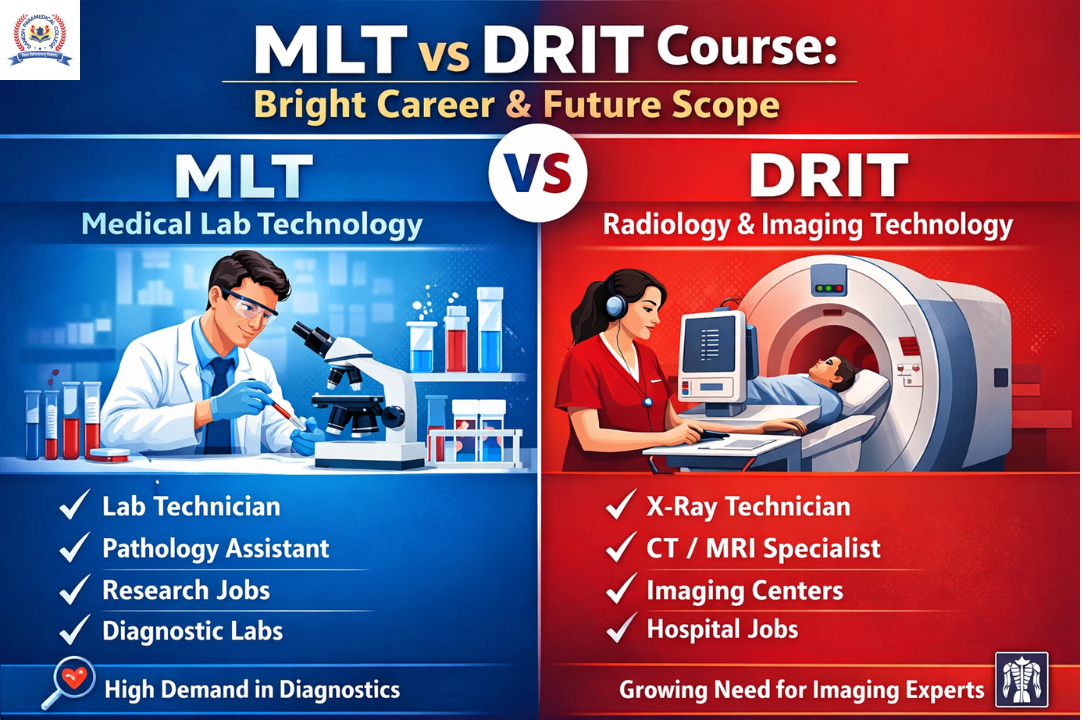
MLT vs DRIT Courses: Future Scope and Career Options
Overview
MLT and DRIT courses are 2 important paramedical courses that help to create
healthcare professionals. These courses help to create skillful professionals who can help
in laboratory techniques and radio imaging techniques. MLT helps to create professionals
who can store, analyze, or take samples, whereas DRIT is related to the radio imaging
techniques, which help with imaging techniques.
What are the Career Opportunities?
After MLT job roles include:
Medical Lab Technician
- Pathology Technician
- Blood Bank Technician
- Microbiology Technician
- Research Lab Assistant
- Lab Supervisor (with experience)
Workplaces :
- Government hospitals
- Private hospitals
- Diagnostic laboratories
- Research institutes
- Blood banks
After DRIT, job roles include:
- Radiology Technician
- X-ray Technician
- CT Scan Technician
- MRI Technician (after training)
- Imaging Assistant
Workplaces:
Radiology departments
- Diagnostic imaging centers
- Trauma centers
- Orthopedic clinics
- Super-specialty hospitals
What is the Future Scope of the MLT course?
Future Scope of MLT :
- Rising demand for diagnostic testing
- Growth of preventive health checkups
- Expansion of pathology chains
- Opportunities in research labs
- Scope for opening own diagnostic lab
MLT professionals can pursue:
- BMLT (if diploma holder)
- MSc MLT
- Specialization in microbiology or hematology
MLT offers long-term stability because laboratory diagnosis is essential in every hospital.
What is the Future Scope of the DRIT Course?
- Increasing demand for imaging tests in hospitals
- Newly constructed diagnostic centers
- Need skillful professionals who know technology
- Expansion of digital radiography
DRIT professionals can upgrade to:
- Advanced Diploma in Radiology
- Bachelor's in Radiology and Imaging Technology
- Specialization in CT/MRI Imaging technology is continuously evolving, creating strong future demand.
What is the Nature of Work?
MLT Professionals
- Work inside laboratories
- Analyze samples
- Prepare diagnostic reports
- Operate lab instruments
- Maintain lab records
They usually have limited direct patient interaction.
DRIT Professionals
- Position patients for imaging
- Operate X-ray, CT, and MRI machines
- Follow radiation safety protocols
- Assist radiologists
- Maintain imaging records
They interact directly with patients during procedures.
What are the Benefits of the MLT Course?
- Stable and essential role
- Less exposure to radiation
- Opportunity to work in research
- Suitable for analytical minds
- Broader diagnostic exposure
- What are the Benefits of the DRIT Course?
- High-tech work environment
- Better salary growth in the imaging field
- Direct patient interaction
- Exposure to advanced machines
Strong demand in hospitals
Key Differences between MLT and DRIT
| S. No. | Factor | MLT | DRIT |
| 1 | Field | Laboratory diagnostics | Radiology imaging |
| 2 | Patient Interaction | Low | Moderate |
| 3 | Technical Equipment | Lab analyzers | Imaging machines |
| 4 | Radiation Exposure | No | Yes (controlled) |
| 5 | Research Opportunities | High | Moderate |
| 6 | Higher Study Scope | Strong | Strong |
Which Course is better?
Choose MLT if:
- You enjoy laboratory work
- You prefer analytical tasks
- You want research opportunities
- You prefer minimal patient interaction
Choose DRIT if:
- You are interested in imaging technology
- You want to work with machines
- You are comfortable with patient handling
- You prefer a dynamic hospital environment
Skills Required :
For MLT:
- Attention to detail
- Strong observation skills
- Patience
- Technical accuracy
For DRIT:
- Machine handling skills
- Good Communication skills
- Physical stamina
- Have Safety awareness