
DMLT vs CRIT Course: Future scope and Career Opportunities

Updated Post: 23 Feb 2026
Share Post:



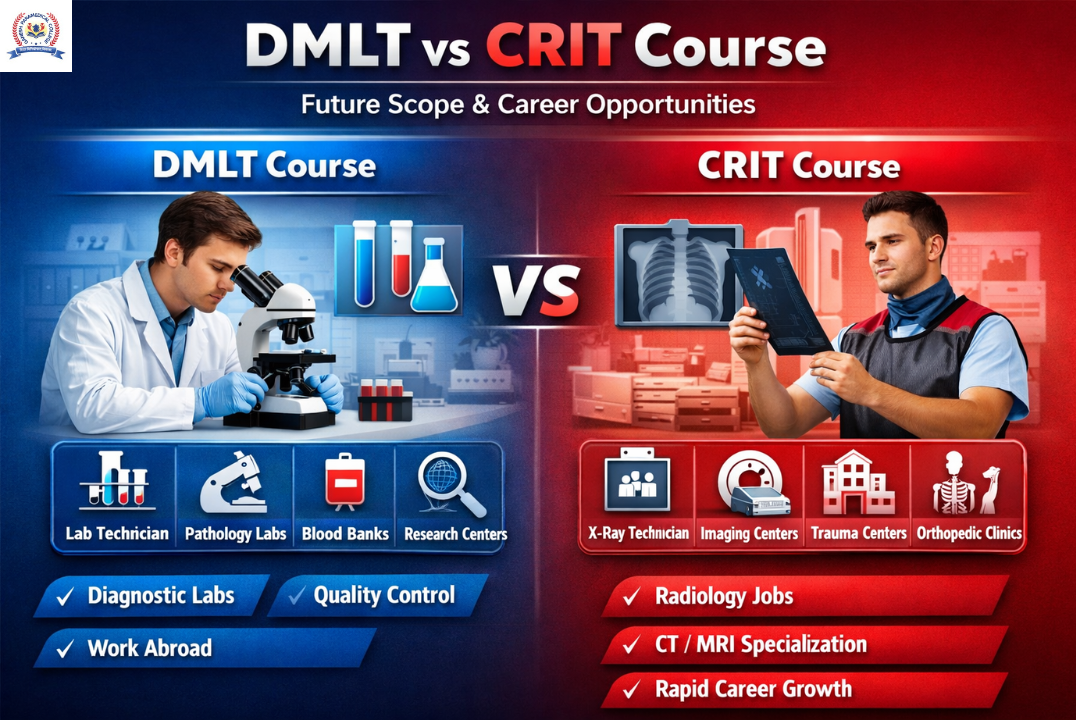
DMLT vs CRIT Course: Future scope and Career Opportunities
Overview
DMLT and CRIT are two important paramedical short duration courses which are used to skill the students for healthcare industry. There is constant need for the trained healthcare professional in both laboratory and imaging diagnostic. These 2 courses are very important and designed to skill the professional related to the testing procedure and imaging techniques to meet the need. There are great career options for these courses with good future growth.
What are the Career Opportunities after DMLT?
DMLT graduates can work as :
- Lab Technician
- Pathology Technician
- Blood Bank Technician
- Microbiology Lab Assistant
- Research Lab Technician
- Lab Supervisor (with experience)
Workplaces
- Government hospitals
- Private hospitals
- Diagnostic laboratories
- Blood banks
- Research centers
- Clinics
What are the Career Opportunities After CRIT?
CRIT graduates can work as :
- X-ray Technician
- Radiology Assistant
- Imaging Technician
- Diagnostic Center Technician
Workplaces
- Radiology departments
- Diagnostic imaging centers
- Orthopedic clinics
- Trauma centers
- Government hospitals
What is the Future Scope of DMLT?
- Expansion of diagnostic chains
- Growth of private hospitals
DMLT professionals can:
- Pursue BMLT (Bachelor degree)
- Start their own pathology lab (with license)
- Move into quality control roles
- Work abroad
Laboratory diagnostics are essential in every hospital, ensuring stable career growth.
What is the Future Scope of CRIT?
Radiology and imaging are also growing rapidly due to:
- Increase in trauma cases
- Advanced diagnostic imaging
- Digital radiography systems
- Government health programs
CRIT professionals can:
- Upgrade to diploma in radiology
- Pursue degree in imaging technology
- Specialize in CT or MRI
However, CRIT is usually a basic-level entry course. Higher qualifications improve growth.
What are the Benefits of DMLT?
- Strong foundation in diagnostics
- High demand in hospitals
- Broader career scope
- Opportunity to start own lab
- Stable and essential healthcare role
What are the Benefits of CRIT course?
- Short duration
- Quick job entry
- Good starting option after 10th
- Exposure to radiology field
- Suitable for students seeking fast employment
Key Differences between DMLT and CRIT
| S. No. | Factor | DMLT | CRIT |
| 1 | Field | Laboratory diagnostics | Radiology & imaging |
| 2 | Duration | Longer | Shorter |
| 3 | Depth of Study | Detailed | Basic |
| 4 | Growth Potential | Higher | Moderate |
| 5 | Technical Exposure | Lab machines | X-ray equipment |
| 6 | Risk Factor | Minimal | Radiation exposure (controlled) |
Which Course is Better?
The answer depends on your interest.
Choose DMLT if:
- You enjoy lab work and microscopic analysis
- You want wider career growth
- You plan to pursue higher studies
Choose CRIT if:
- You want a short-term course
- You are interested in radiology
- You want quick job entry
Skills Required
For DMLT:
- Attention to detail
- Patience
- Analytical skills
- Accuracy
For CRIT:
- Technical handling skills
- Good communication
- Physical stamina
Where to do CRIT and DMLT course in Delhi?
Students can enroll in Ganesh Paramedical College for CRIT and DMLT course with affordable fee. This college provides practical trainings to make the professionals industry ready which helps them to get placed easily in the outside job market. Ganesh paramedical college has own practical labs and experienced faculty for good training and education.
Conclusion
CRIT and DMLT are two short term courses which are designed to meet the increasing demand of professionals for healthcare industry. These courses are designed to meet the need of growth and demand for these professionals. There is good career opportunities and future scope for these courses which can lead to good career growth.