
Biotech Certificate Courses: Skills & Career Guide

Updated Post: 24 Mar 2026
Share Post:



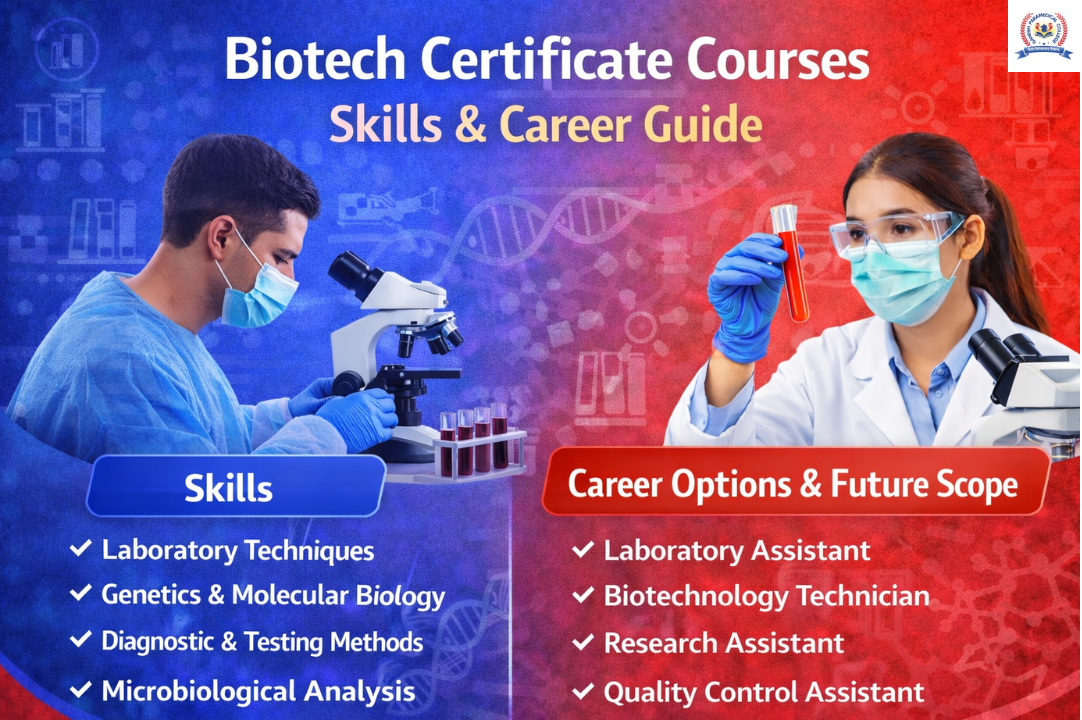
Biotechnology Certificate Courses in Paramedical
Overview
Biotechnology certificate courses are short-duration courses that are designed to create skilled professionals for the healthcare and industry setup. There are various types of biotechnology certificate courses that can be related to a particular domain or to specific techniques in biotechnology, like chromatography, gel electrophoresis, testing techniques, etc. There is good future scope for these certificate courses, and the eligibility can be 12th or graduation, depending on the course type.
What is the Biotechnology Certificate Course?
The biotechnology certificate course is one of the courses with good future scope and is designed to create the skilled professionals for the healthcare industry or pharmacy industry. These courses are short-duration, like 6 months, 1 year, or 2-year certificate courses, which are very helpful and job-oriented. The course includes technical skills like diagnostic methods, genetics, laboratory techniques, and other methods that are used for diagnostic purposes.
Key highlights of biotechnology certificate courses:
- Short duration compared to diploma or degree programs
- Focus on laboratory-based learning and practical skills
- Suitable for beginners interested in biotechnology
- Provides entry-level opportunities in healthcare and research
- Can be pursued after 10th or 12th standard
- Acts as a foundation for higher studies in biotechnology or paramedical fields
Main learning areas covered in the course:
- Basics of biotechnology and life sciences
- Understanding microorganisms and their role in health
- Laboratory safety and handling techniques
- Use of basic laboratory equipment
- Introduction to genetic and molecular biology concepts
Skills developed during the course:
- Sample collection and preparation
- Observation and analysis of biological samples
- Record keeping and report preparation
- Maintaining hygiene and safety in laboratories
- Basic research and testing methods
What is the Syllabus of Biotechnology Certificate Courses?
The detailed syllabus of biotechnology certificate courses includes:
- Basics of Biology
- Microbiology
- Biochemistry
- Cell Biology
- Genetics
- Immunology
- Laboratory Techniques
- Environmental Biotechnology
Practical training includes:
- Use of microscopes and laboratory equipment
- Preparation of culture media
- Identification of microorganisms
- Basic chemical and biological testing
- Handling and storage of biological samples
- Maintaining laboratory cleanliness and safety
Additional training components:
- Introduction to research methods
- Understanding medical laboratory procedures
- Basic computer applications in laboratory work
- Record maintenance and documentation
What are the Benefits of Biotechnology Certificate Courses?
- Short duration allows quick entry into the workforce
- Provides practical knowledge and technical skills
- Affordable compared to long-term degree programs
- Builds a strong foundation for higher education
- Offers flexible career pathways.
What is the Future Scope and career options of Biotechnology Certificate Courses?
There is good future scope and career options like:
- Laboratory Assistant
- Biotechnology Technician
- Research Assistant
- Quality Control Assistant
- Medical Laboratory Helper
Growth opportunities with experience:
- Senior laboratory technician roles
- Research and development positions
- Specialized roles in biotechnology fields
- Supervisory positions in laboratories
Higher education options:
- Diploma in Biotechnology
- BSc Biotechnology
- BSc Medical Laboratory Technology
- Specialized certification courses
Factors driving demand for biotechnology professionals:
- Increase in medical research and development
- Rising need for advanced diagnostic methods
- Growth of pharmaceutical and biotechnology companies
- Expansion of healthcare and laboratory services
- Development of new vaccines and treatments
What are the Workplaces for Biotechnology Certificate Holders?
There are various Common workplaces, including:
- Hospitals and diagnostic laboratories
- Biotechnology companies
- Pharmaceutical industries
- Research and development centers
- Food and agriculture laboratories
- Environmental testing laboratories
- Government health departments
Conclusion
Biotechnology certificate courses are short-duration courses designed to create skilled professionals for the industry. There are various types of techniques and protocols taught in these courses, such as molecular techniques, genetics, and other diagnostic techniques for the industry. These programs are short-duration, with an affordable fee and an effective syllabus for the programme.